
"National Vaccine Information Center," n.d., National Vaccine Information Center.
“It would be tragic if efforts to eliminate or control communicable diseases were to become hampered because the public’s confidence was so eroded as to cause frightened segments of the population to oppose and reject vaccines. Neither can we afford revival of serious childhood epidemics because a complacent and apathetic public, with a diminishing memory, forgets the iron lung.”
—Republican Senator Paula Hawkins of Florida, Chairwoman of the Congressional Hearing
After watching the documentary, Barbara Fisher, Kathi Williams, and Jeffrey Schwartz, who believed DTP caused their children’s brain damage, formed Dissatisfied Parents Together, or DPT (henceforth the movement).
"National Vaccine Information Center," n.d., National Vaccine Information Center.
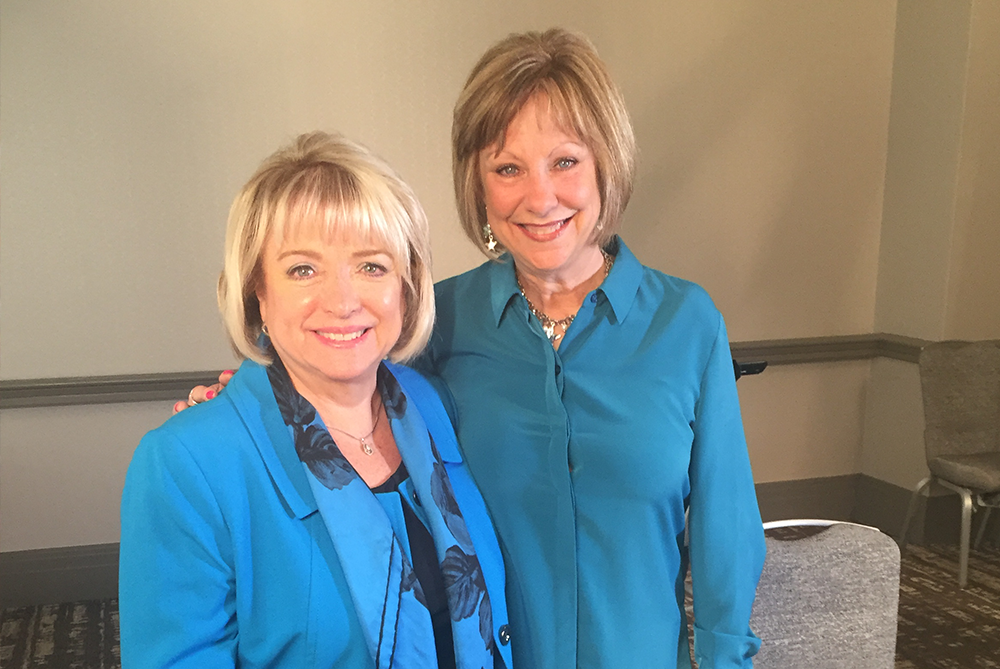
"Barbara Loe Fisher and Kathi Williams," n.d., National Vaccine Information Center.
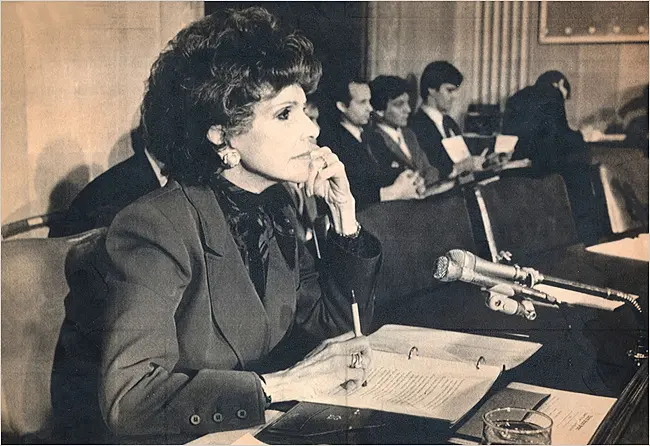
"Senator Paula Hawkins of Florida," 1984, The New York Times.
Eighteen days after Vaccine Roulette aired, Senator Paula Hawkins of Florida called a Congressional hearing to investigate the allegations made by Vaccine Roulette.
Kathi Williams, representing the DPT movement, was the first to testify, presenting seven vaccine safety questions to the government.
"Number one: Although several studies have been done, why has the government had a limited research program dealing with adverse effects of vaccines?
Number two: Why hasn’t a safer vaccine been developed?
Number three: Why haven’t high-risk children been identified?
Number four: Why haven’t physicians been required to report adverse reactions to a central recordkeeping agency?
Number five: Why haven’t physicians and parents been better informed about the possible reactions to the pertussis vaccine?
Number six: Should the state mandate that the present pertussis vaccine be given to all children who attend school?
Number seven: Should there be a compensation program for children who have been retarded or seriously disabled by the pertussis vaccine?"
— Kathi Williams, co-founder of DPT (the organization), during the Senate hearing
Next, the medical community rebutted the documentary as imbalanced and distorted. Afterward, a lengthy scientific report highlighted the documentary’s selective editing, questionable statistics, and dubious experts.

Elizabeth Rasche González, "TV Report on DTP galvanizes US pediatricians," 2 July 1982, Journal of the American Medical Association.
"We at the American Academy of Pediatrics believe it imperative that such sensationalism not go unchallenged."
—Dr. Vincent Fulginiti, Chairman of the American Academy of Pediatrics.
"The program was totally distorted and gave no perspective on the benefit in contrast to the risk [of DTP]."
—James D. Cherry, MD, chief of Division of Pediatric Infectious Diseases, UCLA
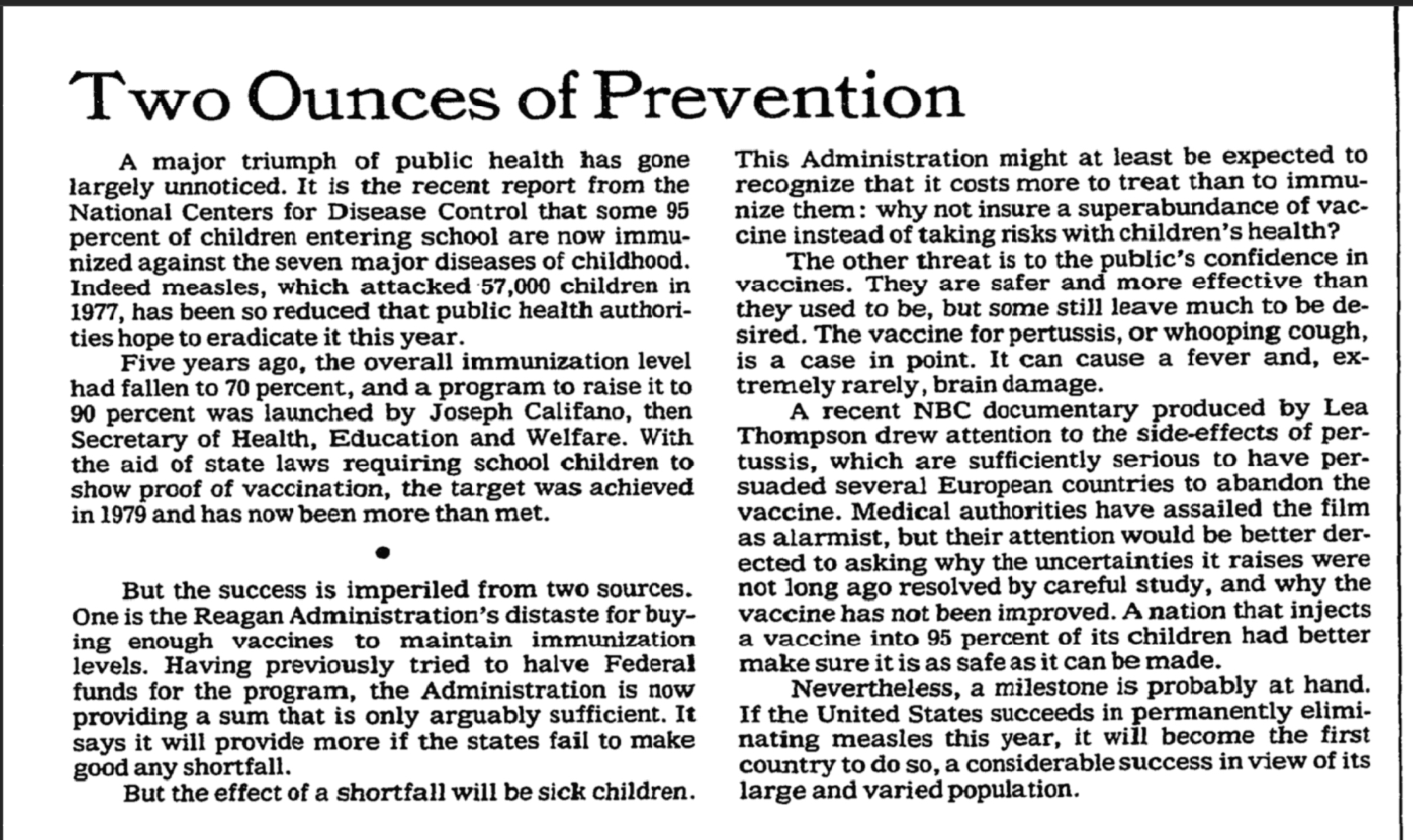
"Two Ounces of Prevention," 18 May 1982, editorial, The New York Times.
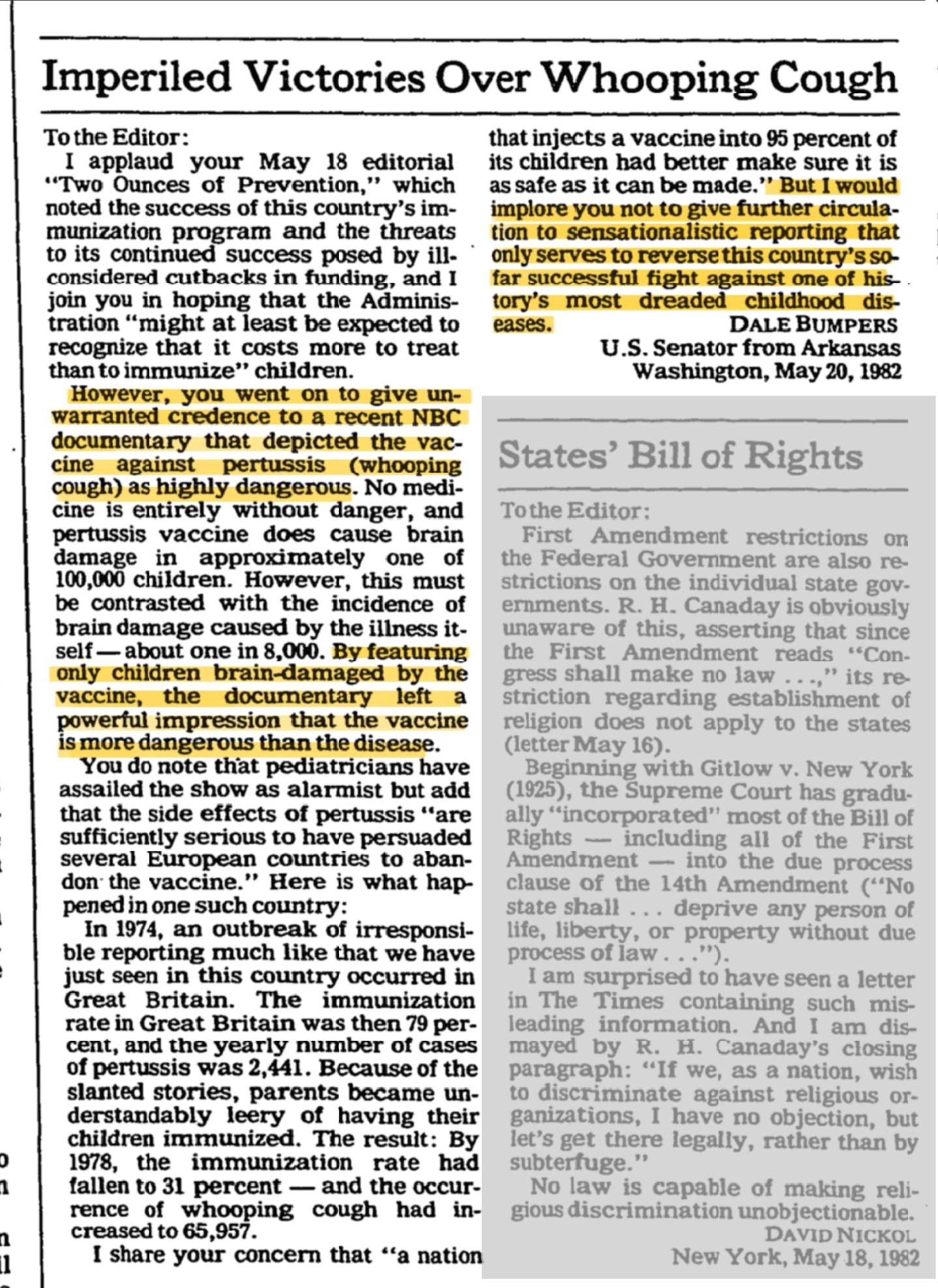
Former Arkansas Governor Dale Bumpers, "Imperiled Victories Over Whooping Cough," 26 May 1982, letter to the editor, The New York Times.
Despite successfully preventing a pertussis crisis similar to Britain’s, the onslaught of negative publicity surrounding the DTP vaccine sowed discord among parents, casting a long shadow of doubt over public health officials and the medical establishment.