“If you look at the crown jewels of modern medicine—antibiotics, vaccines, sanitation—vaccines stand alone in their impact.”
—Dr. Paul A. Offit, an American pediatrician and specialist in immunology
At the turn of the 20th century, smallpox was no longer the deadliest disease, thanks to the vaccine created by Edward Jenner, the Father of Vaccination.
"I avail myself of this occasion of rendering you my portion of the tribute of gratitude due to you from the whole human family. Medecine has never before produced any single improvement of such utility."
— President Thomas Jefferson in an 1806 letter to Edward Jenner
"We shall not fail to teach our children to speak the name of Jenner, and to thank the Great Spirit for bestowing upon him so much wisdom and so much benevolence."
— The Iroquois Confederacy in an 1807 letter to Edward Jenner expressing their deepest gratitude
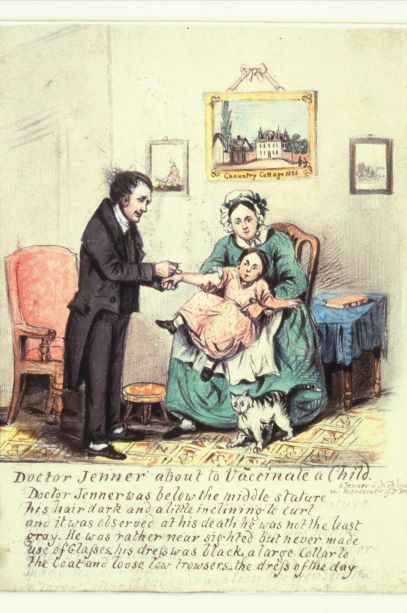
"Doctor Jenner about to Vaccinate a Child," n.d., The Jenner Institute.
The biggest killers of children were diphtheria (the “Strangling Angel of Death”), tetanus (lockjaw), and pertussis (whooping cough). Scientists had identified the bacteria causing diphtheria and tetanus and developed effective vaccines against them. Although the pertussis bacterium was identified in 1906, scientists failed to develop an effective vaccine.
Consequently, by the 1920s, pertussis was the deadliest childhood disease, especially for infants.
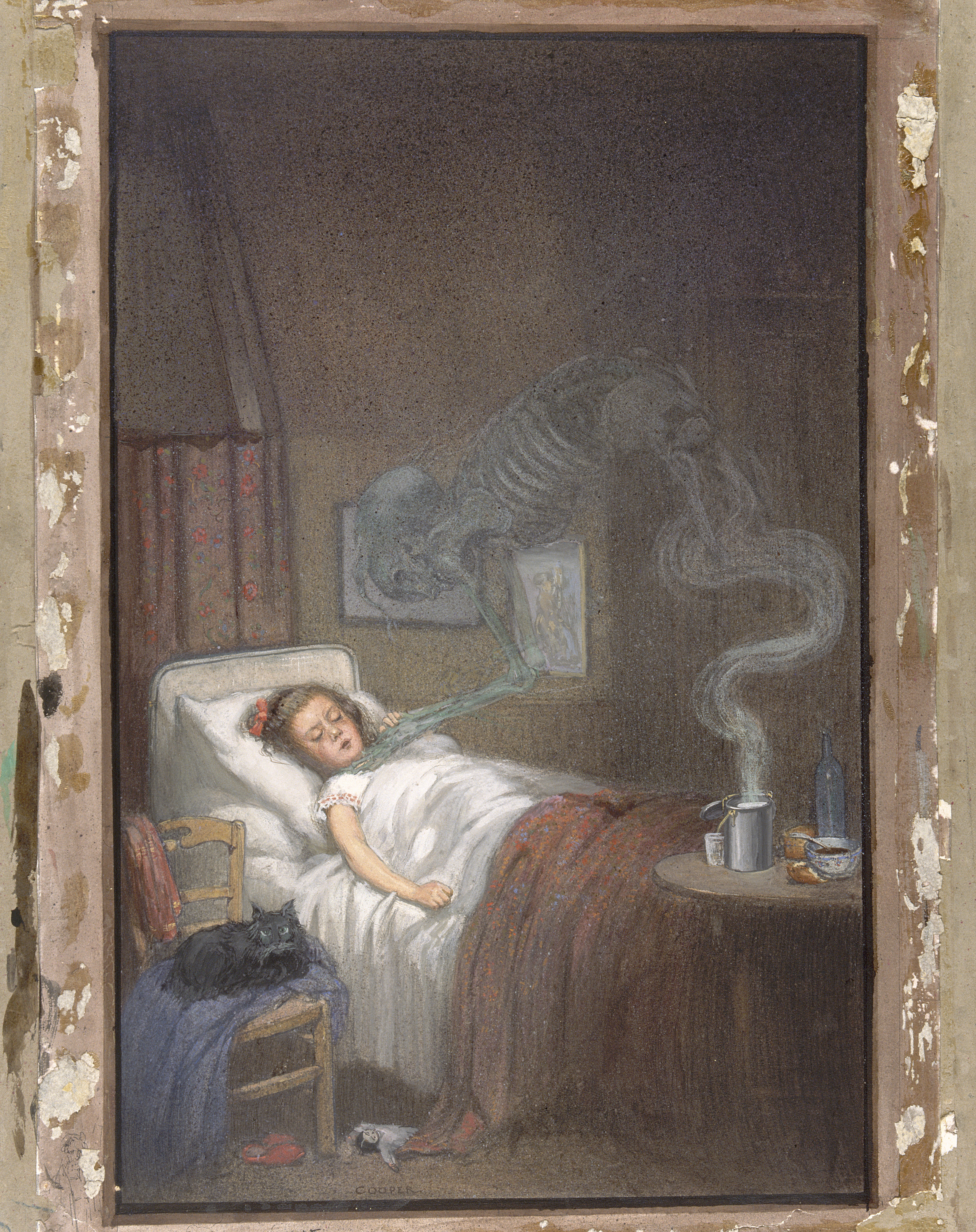
Richard Tennant Cooper, "A Ghostly Skeleton Trying to Strangle a Sick Child; Representing Diphtheria," 1912, The Wellcome Foundation.
“In a typical paroxysm of average severity the child, who can usually foretell it, will often run for support to the lap of the mother or nurse, or seize a chair with both hands. There now occurs a series of explosive coughs, from ten to twenty in number, coming in such rapid succession that the child cannot get its breath between them; the face becomes of a deep red or purple colour, sometimes almost black; the veins of the face and scalp stand out prominently; the eyes are suffused, and seem almost to start from their sockets; there follows a long-drawn inspiration through the narrowed glottis, producing the cowing sound known as the whoop; and then another succession of rapid coughs follows and another whoop…Those old enough to describe their sensations tell of a sense of impending suffocation, the suffering from which is almost indescribable.”
—
A 1922 medical textbook written by L. Emmett Holt and John Howland
“It’s awful, it’s awful. You wonder how they can survive the crisis…They’re suffocating. They’re choking. They become completely blue. They cannot overcome the cough, and you have the impression that the child is dying in your hands.”
— Camille Locht, a researcher at the Pasteur Institute in France.
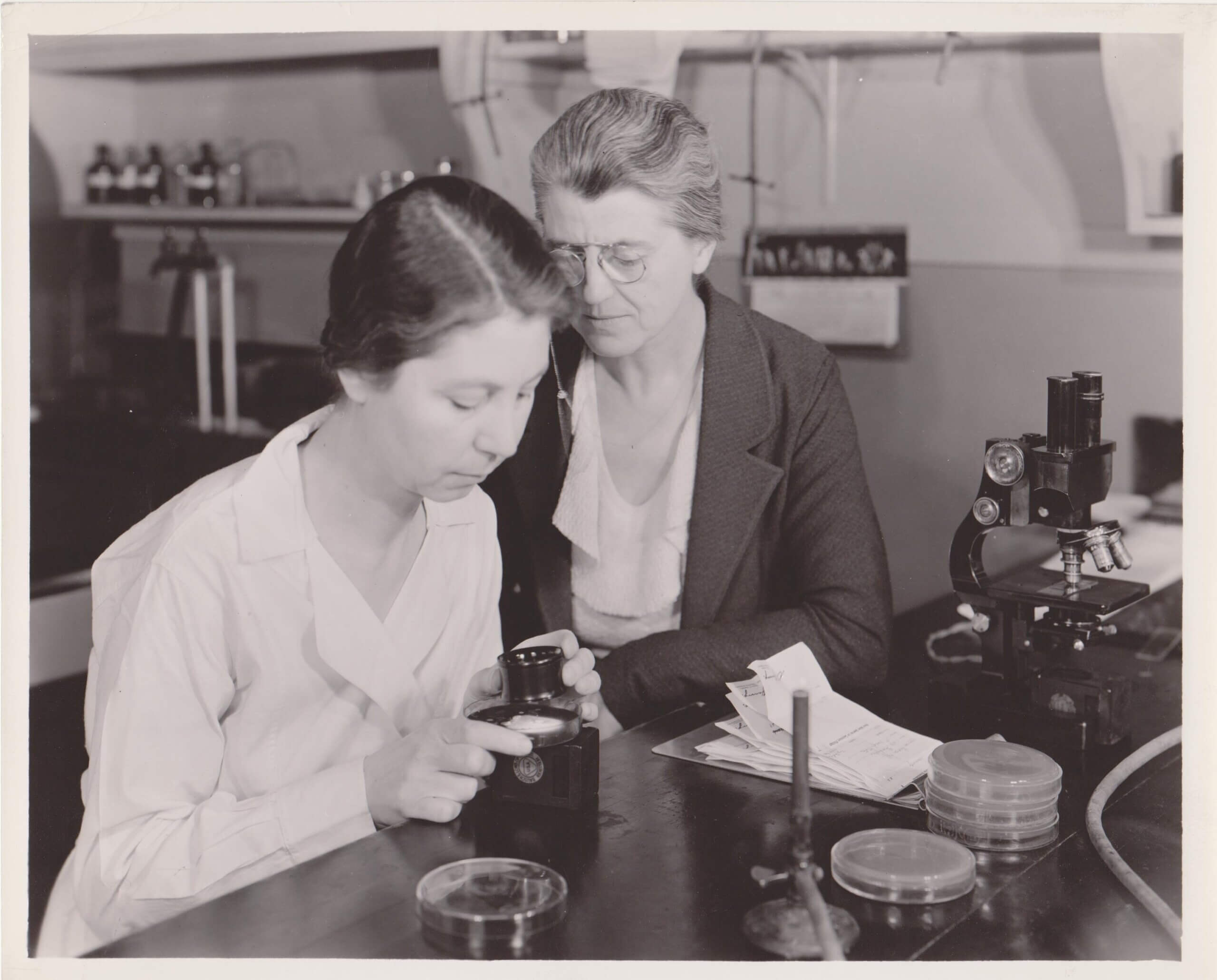
From 1922-1931 about 1.7 million cases were reported in the U.S., with 73,000 deaths, mostly infants. In 1939, two public health scientists, Dr. Pearl Kendrick and Dr. Grace Eldering, developed the first effective whole-cell pertussis vaccine with the help of chemist Loney Gordon.
"Many of the families we visited were very poor and their living conditions pitiful. Our watchword became 'round to the back and up the stairs.' We listened to sad stories told by desperate fathers who could find no work. We collected specimens by the light of kerosene lamps, from whooping, vomiting, strangling children. We saw what the disease could do."
— Grace Eldering, one of the female triumvirate in developing the pertussis vaccine
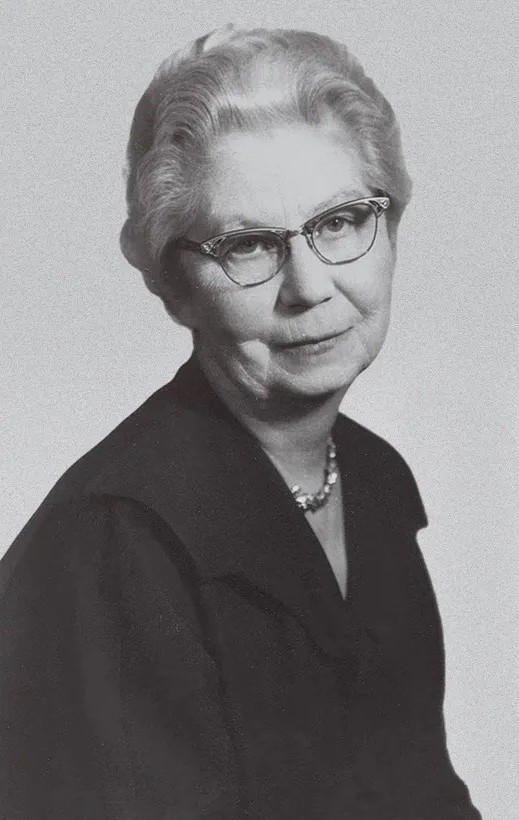
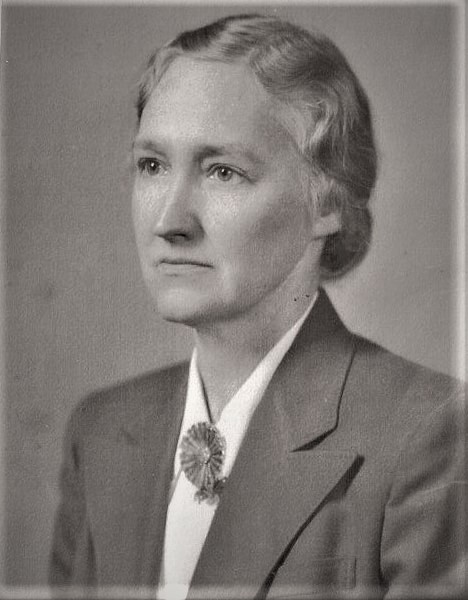
"Pearl Kendrick," n.d., Grand Rapids Public Museum.
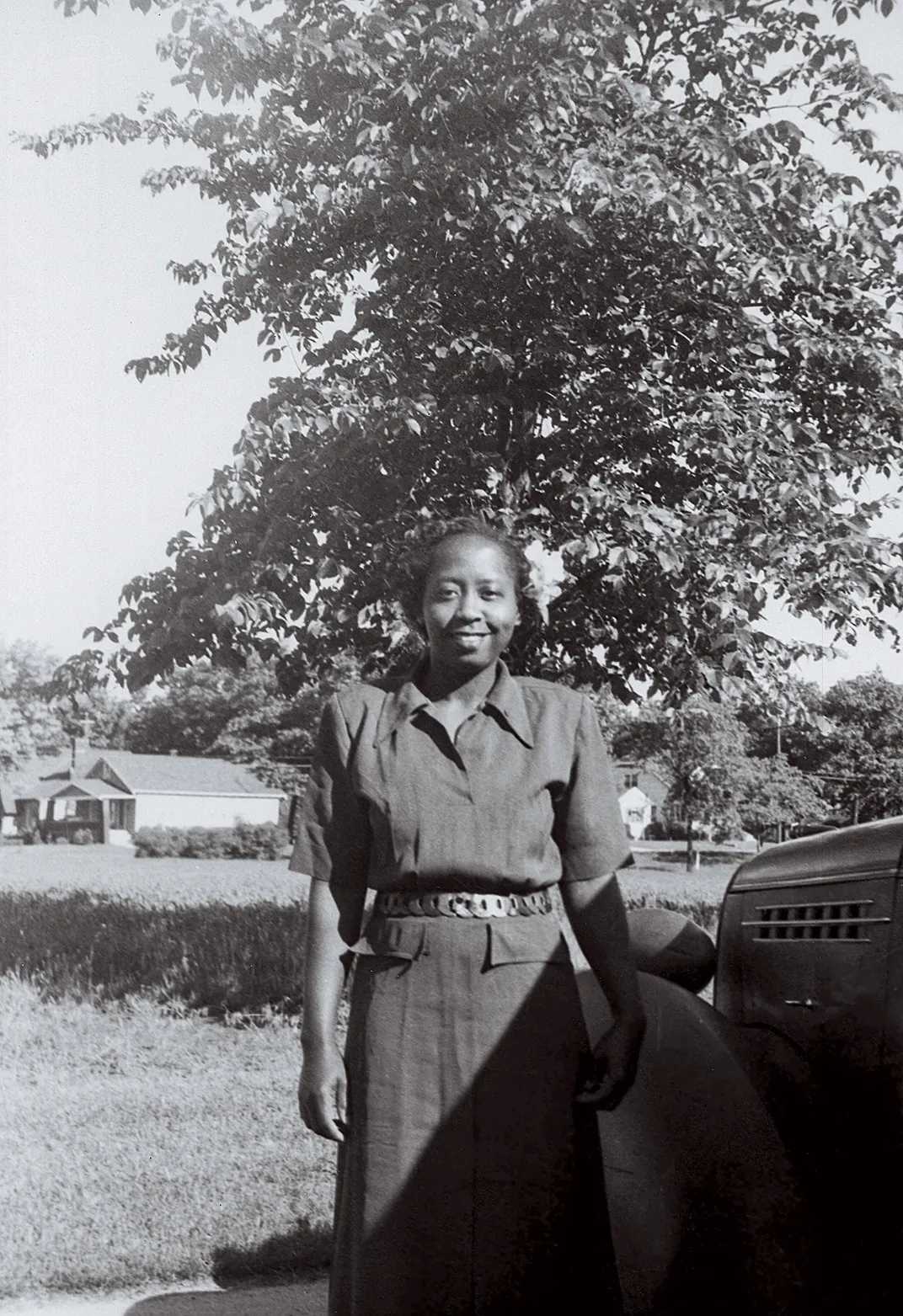
"Grace Eldering," n.d., Grand Rapids History Center.
"Loney Clinton Gordon," n.d., Grand Rapids History Center.
"Margaret Jane Pittman," 1947, Rockefeller University.
Dr. Margaret Pittman, a NIH immunologist, worked with Dr. Kendrick to develop safety tests for the vaccine. In 1948, their pertussis vaccine, as well as the diphtheria and tetanus vaccines, were combined to form DTP vaccine.
“Who are the men and women living today who would be dead from whooping cough had it not been for Pearl Kendrick’s vaccine? … Name one. You can’t do it and neither can I. … Dr. Kendrick never became rich and, outside a relatively small circle of informed friends and colleagues, never became famous. All she did was save hundreds of thousands of lives at modest cost. Secure knowledge of that fact is the very best reward.”
— Dean Richard Remington, in the University of Michigan’s School of Public Health newsletter
Vaccination, like any other medical procedure, is never risk-free. Kendrick’s vaccine contained more than 3,000 pertussis proteins, causing it to have rare but significant side-effects.
“In addition to the usual local inflammatory effects and fever associated with many vaccines, whole-cell pertussis vaccines sometimes trigger prolonged crying and febrile convulsions and, very rarely, hypotonic–hyporesponsive episodes.”
— Nicolas Fanget of the Nature Publishing Group
Although transient side-effects following the shot were real and common, for years doctors had argued the benefits of the vaccine outweighed its risks.